
Automatic Enrollment Supports More Efficient Lead Service Line Replacement
By Jack Travis
Communities and water utilities across the country are working to remove lead service lines (LSLs) as quickly as possible. But limited staff capacity, funding constraints, and administrative hurdles can slow replacement programs. Many utilities plan replacements using block-by-block or neighborhood approaches to maximize efficiency. In practice, these projects often stall during customer engagement and property access phases. Implementing such projects requires the utility or its contractors to engage property owners and residents because, typically, a portion of the LSL is on private property, requiring building access to complete the replacement. Based on the Environmental Policy Innovation Center (EPIC)’s work with utilities, local governments, and community organizations, these enrollment and access phases are often among the most time-consuming parts of LSL replacement. To address this challenge, EPIC has developed a set of best practices designed to streamline these phases of the project that we call automatic enrollment policies.
Automatic enrollment reduces the time and resources required to collect paperwork and makes it easier for utilities to schedule and complete replacement projects. Municipalities and utilities have used these policies (Figure 1) individually or in combination to efficiently replace lead service lines:
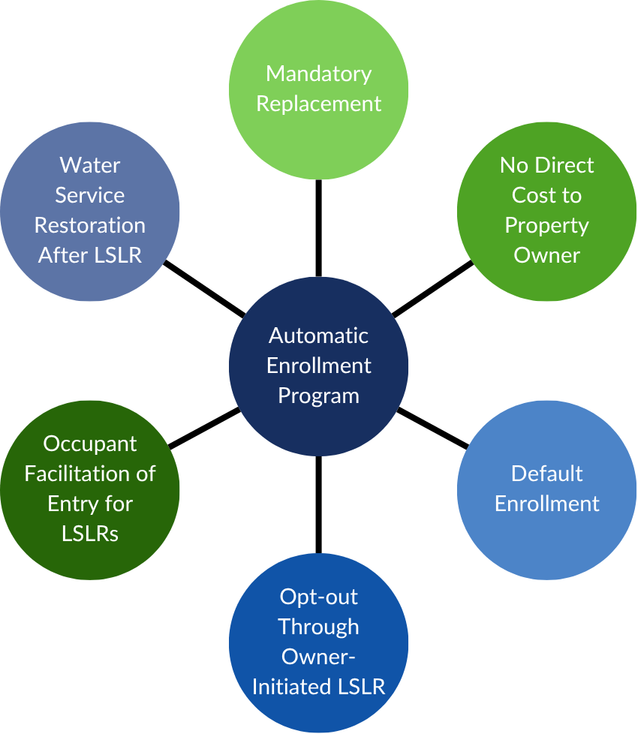
Figure 1: Automatic Enrollment policies
Mandatory Replacement
A replacement mandate is one foundation for automatic enrollment policies. A state or local mandate requires replacement and provides notice to property owners that they must replace the LSL, either as part of a utility-led project or through owner-initiated replacement. These mandates create a legal and administrative framework that allows utilities to implement other automatic enrollment policies, including Default Enrollment, Opt-out Through Owner-Initiated Replacement, and Occupant Facilitation of Entry for LSLRs. Even in the absence of a mandate, however, utilities may still be able to implement automatic enrollment policies under their authority provided by state law.
Many municipalities already have the authority to require LSL replacement. In some states, legislation explicitly empowers municipalities to mandate replacement. In others, municipalities rely on their authority to protect public health. For example, Newark, New Jersey, mandated replacement using its authority to act for the “public health, safety, and welfare.” New Jersey later passed legislation clarifying “that a municipality’s powers to protect the health, safety, and welfare of its residents” allows it to enact LSLR programs and “enter properties to perform lead service line replacements.”
No Direct Cost To Property Owners
Replacing LSLs at no direct cost to property owners can increase participation in block-by-block projects and support implementation of other automatic enrollment policies. When property owners are required to pay for the private-side replacement, participation often declines due to affordability concerns, slowing projects, and increasing the likelihood of more expensive, piecemeal replacements later. Providing replacements at no direct cost encourages participation, allowing utilities to complete more efficient and cost-effective neighborhood-scale projects. To support this approach, utilities may need to draw on a combination of revenue sources, including government grants, loans, bonds, rates, and non-utility funding.
Several municipalities like Milwaukee, WI, Pittsburgh, PA, and Detroit, MI, have replaced LSLs without requiring a private-side cost share in their block-by-block projects. Some municipalities have not been able to subsidize the entire private-side cost share, and used alternative approaches to avoid upfront costs for property owners. For example, Columbus, OH offers an assistance program with no upfront charge and instead places an interest-free, 99-year lien on the property, typically repaid when the property is sold. Ridgewood, NJ similarly charges nothing upfront and recovers the private-side cost through property taxes over 30 years.
Default Enrollment
Water utilities that enroll properties by default in block-by-block projects — without requiring owners to complete enrollment or consent forms — can reduce unnecessary and potentially confusing communications. Utilities should still attempt to collect an acknowledgement that includes information needed to schedule and facilitate entry for replacement. However, utilities should be able to enroll properties in the project and proceed without such an acknowledgement.
In some cases, under state law, utilities may be able to proceed without a completed right of entry form or explicit property owner consent. If state law mandates replacement or general utility law grants utilities the authority to access property to make repairs or replacements, utilities may already have the legal basis to enter properties to replace LSLs. In these cases, right-of-entry forms may be unnecessary, as long as an occupant provides access to complete the work.
Alternatively, mandatory replacement policies adopted at the local level can also support default enrollment. When replacement is required by ordinance, utilities may need to proceed with replacements at properties with unresponsive owners in order to bring the property into compliance. Under these policies, if owners do not replace the LSL through their own initiative, the property is automatically included in the utility’s replacement program (see Opt-out Through Owner-Initiated Replacement). Utilities can therefore enroll households without express owner consent and rely on occupants to facilitate access for the work.
For example, Newark performs replacements even when owners do not sign up for the program or return right of entry forms. New Jersey’s legislature subsequently clarified that, under municipal authority to protect the public health, safety, and welfare, municipalities need only provide notice to owners and occupants before entering private properties to perform replacements. Similarly, Wisconsin law authorizes utilities to enter property to repair, install, or remove water supply pipes, which could provide the legal basis for a Default Enrollment approach.
Opt-Out Through Owner-Initiated Replacement
Requiring owners to prove they’ve replaced their portion of the LSL within a specified timeframe as a condition of opting out of automatic enrollment in a utility-initiated project prevents delays and scattered follow-up replacements later. The policy places the onus on property owners to demonstrate that they should not be included in utility-initiated projects. This enables utilities to finalize project scopes more quickly and complete replacements more efficiently. Indiana gives owners the option to replace their own LSL and empowers utilities to replace the LSLs of noncompliant or unresponsive owners.
Occupant Facilitation of Entry for LSLRs
To complete replacements, utility workers must access the water meter, which is typically located in the basement or elsewhere within the property. As a result, entry to the building is often necessary. Utilities that can proceed with replacements based on occupant-provided access can complete block-by-block projects more quickly by avoiding delays caused by unresponsive or uncooperative landlords.
Whether based on a municipal Mandatory Replacement policy or state law authority, under the Default Enrollment policy, water utilities don’t need explicit owner permission to enter properties for replacements. In these cases, occupants can facilitate access for the work. To further empower tenants, LSL replacement programs should make it clear that occupants who allow access are not liable for the work performed. Utilities typically have the authority to enter property to replace LSLs to ensure compliance with replacement mandates or other public health requirements. Newark and Detroit have adopted policies that allow occupants to facilitate replacements and protect them from liability for damages related to the work. Indiana law similarly allows utilities to seek access from occupants of certain buildings when property owners fail to comply with replacement requests and holds occupants harmless for facilitating access.
Water Service Restoration After Replacement
During LSL replacement projects, utilities must temporarily disconnect water service while workers replace the line. Policies that condition reconnection on completing the replacement can help utilities complete more replacements and reduce the follow-up, tracking, and outreach required under the Lead and Copper Rules when a utility is unable to replace an LSL.
Utilities that can condition reconnection on access for replacement may be able to replace more LSLs through cost-effective block-by-block projects. At the same time, utilities should ensure that they restore service promptly following replacement.
To protect public health, utilities should restore service even if there are outstanding arrearages or if a private-side cost share has not been paid. Utilities should also adopt clear policies stating that water service will not be disconnected due to unpaid private-side replacement cost-shares.
Adopting and clearly communicating these policies ensures that: 1) owners and occupants do not lose service due to an inability to pay, and 2) occupants in rental properties do not lose service because of an owner’s arrearages. Clear restoration policies allow owners and occupants to participate in LSL replacement projects without fear that participation could result in service disconnection.
Conclusion
Automatic enrollment policies give utilities practical tools to maximize participation in block-by-block replacement projects and keep those projects moving efficiently and on schedule. Many municipalities have the authority to adopt these policies, and state legislation can further support efficient LSL replacement programs by clarifying that authority.
More households in block-by-block projects means lower overall replacement costs. Less paperwork means less time and money spent on follow-up, reducing the time spent tracking down forms and increasing resources available to complete replacements.
For more information on the automatic enrollment policies summarized here, including examples of cities already implementing these approaches and flow charts illustrating how they streamline outreach processes, see EPIC’s recently published Automatic Enrollment white paper. For tailored guidance on adopting and implementing these policies in your jurisdiction, please contact contactwater@policyinnovation.org. Utilities interested in technical assistance to access water infrastructure funding can also submit a request through EPIC’s Funding Navigator program.
Jack Travis is the Water Law Fellow at the Environmental Policy Innovation Center (EPIC), a nonprofit start-up of policy experts and practitioners, technologists, advocates, and researchers working to accelerate better environmental and public health outcomes. EPIC’s Water Program provides data analysis, policy recommendations, and technical assistance to improve access to safe, reliable, affordable water infrastructure. Jack is a Member of the New York Bar and a graduate of NYU School of Law, where he was the digital executive editor of the Review of Law and Social Change. He interned at EPIC prior to his Fellowship and also interned with NRDC and the Office of the New York Attorney General. He holds a bachelor’s degree in economics from the University of Wisconsin-Madison.