
Application-Specific Modifications Enhance Strainer Efficiency
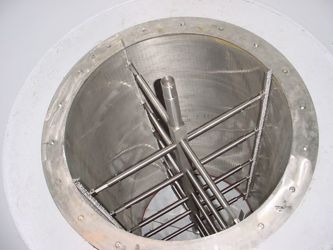
Targeted modifications can enhance the performance of automatic self-cleaning scraper strainers while expanding their applicability and long-term value across a wide range of industrial environments
For industrial plant managers, automatic scraper strainers are among the closest solutions to a true “set-and-forget” system, effectively removing both large and fine suspended solids from industrial water, cooling tower water, liquids, and slurries.
The basic design represents one of the most efficient and cost-effective industrial self-cleaning strainers available. The motorized unit is engineered for minimal maintenance and operator involvement and can remove solids as small as 75 microns. These strainers allow for continuous, uninterrupted flow, including during blowdown cycles.
Cleaning is performed by a spring-loaded blade and brush system controlled by a fully automatic control unit. The two blades and two brushes rotate at 8 RPM, producing an effective cleaning rate of 32 passes per minute. The scraper brushes penetrate the wedge-wire slots to dislodge stubborn particulates and adhered solids.
This design enables the scraper strainers to resist clogging and fouling even in applications with large debris and high solids concentrations. It also ensures a complete cleaning and is very effective against biofouling.
However, incorporating minor customizations or application-specific modifications can further optimize the automatic scraper strainer’s performance and suitability for a given application, according to Robert Presser, President of Acme Engineering Products, Inc., a North American manufacturer of industrial self-cleaning strainers. Acme Engineering Products, Inc. is an ISO 9001:2015–certified manufacturer of environmental control systems with integrated mechanical, electrical, and electronic capabilities.
Presser recommends the following design refinements that can improve overall effectiveness and operational results of scraper strainers for specific applications.
Choose the Screen Best Suited to the Application
Scraper strainers are available in various screen constructions, each engineered to address different process requirements and operating conditions.
Reverse-formed wedge wire screens are the standard configuration and are widely used due to their mechanical strength, long service life, and resistance to deformation under high differential pressures. Their smooth, continuous slot profile minimizes particle wedging and allows effective use of automatic brush cleaning mechanisms, making them well suited for continuous-duty and demanding industrial applications.
For processes that require finer filtration or more precise particle retention, multilayer sintered metal mesh screens are the preferred option. These screens consist of multiple layers of woven wire mesh bonded together to form a rigid, porous structure. This construction provides consistent and accurate filtration ratings while maintaining good permeability and structural stability, making them suitable for applications involving fine solids or strict product quality requirements.
In applications handling fibrous or stringy materials—such as those commonly encountered in the pulp and paper industry—perforated screens with round holes offer superior performance. The round-hole geometry reduces the tendency of fibers to lodge in the openings, promoting easier self-cleaning and more reliable operation. As a result, these screens help maintain stable flow conditions and reduce the risk of blinding in fiber-laden process streams.
Affordable Solutions for More Effective Solids Removal
Scraper strainers allow the solids to accumulate at the bottom of the vessel, where the blowdown valve will open periodically to clear them out. Blowdown occurs only at the end of the intermittent scraping cycle when a valve is opened for a few seconds to remove solids from the collector area. Liquid loss is minimal, accounting for less than one percent of the total system flow.
If additional pressure is required to clean the screen, however, an inexpensive trash pump can be added to the blowdown line to assist in removing the solids, debris, and sediment that collect in the strainer sump.
Alternatively, the sump can be replaced by a cylinder bracketed by two gate valves that open and close as needed to remove the solids waste.
“When you are ready to empty the cylinder, you close the top gate valve momentarily and open the bottom one by depressing a button to dump the accumulated solids into a receptacle like a dump truck or a conveyor bucket so there is no manual handling required,” says Presser.
Add a Macerator to Break Up Large Solids
For applications with high solids loading that are prone to clogging, a macerator can be installed upstream of the automated scraper strainer. This solution accommodates heavy solids loading while ensuring uninterrupted flow and dependable, clog-free performance.
“The design effectively delivers a one-two punch, with the macerator breaking down large solids into smaller fragments and the automated scraper strainer efficiently filtering out the debris along with the tiny particles,” explains Presser.
The combination of these two established technologies is already being applied to some of the toughest, dirtiest straining applications including wastewater debris, power plant boiler water slag, asphalt transloading, and meat processing waste streams.
Specify Fiber-Reinforced Plastic (FRP) Construction
When the chemical properties and temperature of the process fluid raise concerns about material compatibility, automated scraper strainers are available in other materials such as Monel, D2205, SD2507, and even Fiber-Reinforced Plastic (FRP). The internal mechanism and wetted components can be manufactured from super duplex or similar high-performance steels.
Although standard carbon steel construction is adequate for typical use, corrosive environments such as those involving seawater, erosive slurries, or aggressive chemicals can quickly corrode conventional equipment. This can lead to potential issues in safety, quality, and compliance as well as production downtime, requiring premature strainer component replacement.
In many industries, duplex or super duplex stainless-steel construction is used to resist corrosion, but at considerable cost.
Today, a much more cost-effective option is to utilize Fiber-Reinforced Plastic (FRP) strainers that are specifically designed to be resistant to corrosive environments at a fraction of the cost of duplex or super duplex stainless steels.
Presser points out that FRP can be used for external strainer construction, including for pressure vessel applications up to 300 PSI. The internal mechanism is still manufactured with super duplex or similar steels. With this approach, manufacturers can reduce costs by approximately 50 percent or more while maintaining required performance standards.
As a result, OEMs are increasingly adopting fiber-reinforced plastic (FRP) for applications that demand high corrosion resistance without the expense associated with traditional materials. Typical uses include desalination systems, wastewater treatment, irrigation infrastructure, power generation facilities, and equipment used in the manufacture of food, pharmaceuticals, and both consumer and industrial products.
Easy Field Conversion Between Backwash and Scraper
Most manufacturers of automatic filtration systems commit to either backwash or scraper-style cleaning mechanisms, resulting in equipment that is optimized for only one mode of operation. This often leaves end users with limited flexibility if process conditions change or if the original filtration technology proves to be less effective than anticipated.
According to Presser, Acme Engineering distinguishes itself by offering automatic filtration equipment that can be readily converted in the field between backwash and scraper operation, without requiring a complete system replacement.
Although Acme’s core design philosophy is centered on scraper-based filtration, its filter housings are engineered from the outset to support both scraper and backwash cleaning assemblies. This dual-compatibility design allows the internal cleaning mechanism to be changed using modular components, rather than replacing the entire filter body or piping connections. As a result, operators can transition from one cleaning method to the other with minimal downtime and disruption to ongoing operations.
This flexibility provides a significant advantage for facilities where operating conditions change over time. It also reduces the risk associated with specifying the wrong filtration technology during the design phase.
Simplifying Backwash Strainer Upgrades
Although many industrial facilities operate with under-performing backwash strainers, they are often reluctant to pursue replacement or upgrades due to the perception that installation will require extensive and costly piping modifications.
These concerns can be addressed through equipment designs that prioritize customization and retrofit compatibility. Custom-engineered pressure vessels and filtration housings can be manufactured to integrate seamlessly with existing piping configurations, eliminating the need for wholesale system redesigns.
“Filtration units can be designed to drop directly into the existing system footprint. This approach minimizes the need for rework of upstream and downstream piping, reduces installation labor, and shortens system downtime,” says Presser.
In many cases, the new filter can be installed during a scheduled maintenance window, avoiding extended production interruptions.
Automatic scraper strainers deliver a durable, self-cleaning solution that performs consistently across a wide range of operating conditions. Their ability to handle high solids loading and fluctuating process demands while maintaining continuous operation translates directly into improved reliability, reduced downtime, and lower maintenance requirements.
In addition, the inherent flexibility of automatic scraper strainers allows for application-specific customization, enabling design refinements that further enhance performance where needed. This adaptability ensures optimal filtration efficiency and long-term operational effectiveness, even in demanding or highly variable service conditions.
Source: ACME Strainers