
After The Fire: What The 2026 Wildfires And El Niño Could Mean For U.S. Lakes And Reservoirs In 2027
By Dave Shackleton
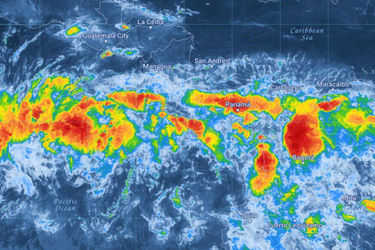
In July, smoke from Canadian wildfires spread across the upper Midwest and Northeast. Now a strengthening El Niño is set to influence the coming winter. Both events matter to lake and reservoir managers because their effects on water quality will continue to emerge long after the skies clear or the El Niño passes.
The immediate management task is to determine how the events of 2026 might increase oxygen deficits and bioavailable nutrients before they manifest as toxic blooms in summer 2027.
Wildfire Smoke Delivers Nutrients To Watersheds
Smoke carries fine particles far beyond the area burned. Some settle directly onto lakes; others fall across roads, fields, and forests, where later rain washes them into streams and reservoirs. Rain can also capture material from smoke while it is still airborne.
An August 2026 study examined smoke and precipitation chemistry at more than 250 National Atmospheric Deposition Program sites during 2014, 2020 and 2022 — three years with substantial wildfire activity. On days when smoke and rain coincided, wet deposition increased for all nine ions the researchers measured. The largest average increases included orthophosphate and ammonium, nutrients that support aquatic growth. In the Northeast, each additional smoke and rain day was associated with roughly double the weekly wet orthophosphate deposition.1
The July 2026, Canadian fires exposed northeastern watersheds to this nutrient delivery pathway. The amount reaching an individual reservoir depends on local deposition, subsequent rainfall and the routes runoff takes through its watershed. In several northeastern lakes and reservoirs that we manage, we observed increased algal and cyanobacterial populations in the weeks following the smoke as August rainfall delivered additional material that had settled across the surrounding land.
Those observations call for continued monitoring. A bloom that fades in autumn does not necessarily mark the end of the response. Some of the material delivered this summer will settle and decompose; its effects will be apparent at depth before they appear at the surface.
El Niño Is Already Changing The Weather
On September 10, NOAA reported that El Niño was strengthening and placed the probability of a very strong event during fall and winter 2026–27 above 90%.2
Its influence is already visible in a striking way that has not registered with most people: as of late September, the Atlantic has not produced a single hurricane this year. El Niño tends to increase vertical wind shear over the tropical Atlantic, disrupting storms before they can organize into hurricanes. The season is still underway, but its lack of hurricanes so far is a striking demonstration that a shift in the Pacific can alter weather thousands of miles away.3
The next question for reservoir managers concerns the coming winter. El Niño often shifts the U.S. storm track southward. Northern areas tend toward warmer, drier conditions, while parts of the southern United States tend toward cooler, wetter conditions.
A warmer winter can change how long a lake remains ice covered and whether its deepest water is fully reoxygenated during seasonal turnover. Both outcomes affect the condition in which the water body enters spring.
We have documented lakes and reservoirs in which only the upper portion of the water column mixed during the expected turnover period in warmer winters. Deep water remained hypoxic through winter and into the next growing season. That carried oxygen deficit gave internal nutrient recycling a head start before summer warming began.
Lake Superior shows how consequential the effects of an exceptional winter can be. Researchers identified a marked, sustained shift in its physical conditions following the warm 1997–98 El Niño winter. Over the subsequent period studied through 2010, average maximum ice cover fell from 69% to 36%, the average ice season shortened by 39 days, summer surface water was approximately 2–3°C warmer, and July–August evaporation averaged 91% higher than before the shift.4
Since then, Lake Superior has experienced cyanobacterial blooms, including one reported along roughly 12 miles of shoreline in 2012 and a far larger event across 60 miles in 2018. Toxic HABs have since occurred nearly every year, and by September 11 this year, the Wisconsin DNR had recorded seven blooms in the Duluth–Superior inner harbor and St. Louis River estuary alone.5 This show that a change beginning in one mild El Niño winter can persist for years and cause a permanent change in HAB risk.
The Risk Develops Beneath The Surface
When runoff carries organic matter into a reservoir, much of that material settles. Bacteria consume oxygen as they break it down.
Hypoxic water over the sediment promotes the release of stored phosphorus in many lakes. Ammonium also accumulates in deep, oxygen-depleted water. This creates a supply of bioavailable nutrients long after the original watershed pulse has ended.6
The sequence is especially concerning when one disturbance follows another. Summer smoke deposition and autumn runoff can add organic matter and nutrients. A warm winter can limit deep water reoxygenation by turnover. Spring runoff can bring another load into a reservoir already carrying an oxygen deficit. By summer, internal nutrient recycling and favorable growing conditions can support a cyanobacterial bloom.
The same sequence affects drinking water operations before a visible HAB develops. Runoff changes turbidity and raw water chemistry. Deep water oxygen loss can change conditions at intake elevations. Reservoir managers need to track those changes as part of source-water management and HAB risk management.
Treat Hypoxia And Habs As A Risk Management Problem
The Government Accountability Office’s 2022 review called for a stronger, risk-based approach to the management of harmful algal blooms and hypoxia. It found that the federal strategy lacked a prevention goal and recommended expanded freshwater monitoring and forecasting.7
At reservoir level, prevention begins with a measured risk profile. Managers need to know whether the hypoxic zone is expanding, whether nutrients are accumulating within it, and whether the phytoplankton community is shifting toward cyanobacteria. Those changes can be tracked before a toxic bloom forces an emergency response.
The 2026 disturbances make autumn and winter measurements particularly important. Waiting for a green surface next summer would miss the period in which the reservoir’s vulnerability is developing.
What Managers Should Measure Now
Profile temperature and dissolved oxygen from surface to sediment. Take measurements at regular depth intervals at the deepest point and at other stations needed to represent the reservoir’s basins and intakes. Track the depth at which water becomes hypoxic (DO below 2.5mg/L). Repeat profiles during and after expected fall and spring turnover to establish whether deep water fully reoxygenated.
Calculate the scale of hypoxia. Combine oxygen profiles with bathymetry to determine the volume of hypoxic water and the sediment area exposed to it. A deeper or more extensive hypoxic zone quantifies deterioration that a surface sample will miss. Tracking both measures over time shows whether the reservoir is entering the next growing season with an oxygen deficit and greater internal nutrient recycling potential.
Measure nutrients within that zone. Total phosphorus and total nitrogen describe overall nutrient concentrations, but they do not reveal how much orthophosphate and ammonium are accumulating in deep water. Sample those bioavailable forms at relevant depths in hypoxic water.
Track the phytoplankton community. Chlorophyll-a provides an estimate of overall algal biomass but cannot show which organisms are gaining ground. Identification and counts reveal whether cyanobacteria are increasing as a share of the community.
The purpose is to build a time series that connects weather events to changes within the reservoir. The July fires, autumn rainfall, winter mixing, and spring runoff will not produce the same result in every lake. Consistent measurements show how each waterbody has responded and whether its risk is rising.
The smoke has cleared, but the material deposited across affected watersheds has not necessarily left the system. El Niño’s influence on the coming winter is still developing. Managers who measure oxygen at depth, the extent of hypoxia, bioavailable nutrients, and phytoplankton composition will know whether the events of 2026 are becoming a water quality problem in 2027 while there is still time to act.
This video explains the threat El Niño poses to lakes and reservoirs in more detail
Sources:
- Ponette-González et al. (2026), “Smoke-Affected Rain Fertilizes Terrestrial and Aquatic Ecosystems,” Global Change Biology. https://doi.org/10.1111/gcb.71050
- NOAA Climate Prediction Center, ENSO Diagnostic Discussion, September 10, 2026. https://www.cpc.ncep.noaa.gov/products/analysis_monitoring/enso_disc_sep2026/ensodisc.shtml
- NOAA Atlantic Oceanographic and Meteorological Laboratory, “How Does El Niño Impact Atlantic Hurricane Season?” https://www.aoml.noaa.gov/how-does-el-nino-impact-atlantic-hurricane-season/; Atlantic season status as of September 29, 2026.
- Van Cleave et al. (2014), “A regime shift in Lake Superior ice cover, evaporation, and water temperature following the warm El Niño winter of 1997–1998,” Limnology and Oceanography. https://doi.org/10.4319/lo.2014.59.6.1889
- “Experts urge swift action to address harmful algal blooms on Lake Superior” https://www.wpr.org/news/experts-urge-swift-action-harmful-algal-blooms-on-lake-superior?m
- Steinman et al. (2020), “Internal phosphorus loading in lakes: Causes, case studies, and management.” https://hero.epa.gov/reference/10369675/
- US Government Accountability Office (2022), Water Quality: Agencies Should Take More Actions to Manage Risks from Harmful Algal Blooms and Hypoxia, GAO-22-104449. https://www.gao.gov/products/gao-22-104449
Dave Shackleton (daves@sis.bio) is president of SIS.BIO.