
Advanced Membrane Filtration Technologies: Choosing The Right Solution For Modern Water Treatment Plants
Water treatment is moving beyond simply removing contaminants. Modern plants increasingly focus on precision separation, energy efficiency, water recovery, fouling control, and real-time optimization. In 2026, research is accelerating around nanofiltration (NF), graphene-based membranes, hybrid treatment trains, artificial intelligence (AI), and lower-energy desalination.
According to DataIntelo, the global membrane filtration market was valued at $5.14 billion in 2025 and is projected to reach $9.71 billion by 2034, growing at a 7.2% CAGR. Growth is driven by rising demand for advanced water treatment, wastewater recycling, desalination, and high-purity water across municipal and industrial applications. Increasing water stress, stricter regulations, and reuse targets are further accelerating adoption, with factors such as flux, rejection, recovery, energy consumption, membrane life, and cleaning frequency shaping technology selection.
Why Membrane Selection Is Changing
Microfiltration (MF), ultrafiltration (UF), nanofiltration (NF), and reverse osmosis (RO) operate at different separation scales. NF provides tighter separation, while RO offers the strongest barrier against dissolved salts.
Operating pressure also changes significantly. UF commonly operates at approximately 1–5 bar, NF around 5–25 bar, and RO can range from roughly 10–80 bar, depending on whether the feed is brackish water or seawater. Consequently, applying RO to every treatment stage can increase energy consumption when a lower-pressure membrane could accomplish the required separation.
NF Moves Into The Efficiency Conversation
These technologies can reduce pressure demand while preserving required water quality and treatment performance.
Recent research is expanding NF materials beyond conventional thin-film composites. Covalent organic frameworks (COFs), metal-organic frameworks (MOFs), graphene oxide (GO), MXenes, and hybrid nanomaterials are being investigated to improve permeability and selectivity simultaneously.
Graphene-Based Membranes Move Toward Engineering
Graphene oxide is among the most actively researched advanced membrane materials because its nanoscale structure can potentially improve water transport while maintaining strong contaminant rejection.
A 2025 study reported a GO-modified NF membrane achieving 98.14% sodium sulfate rejection and a water flux of 50.47 L/m²/h at 0.4 MPa under laboratory conditions. Flux-recovery rates reached 92.57% for bovine serum albumin, 97.39% for humic acid, and 98.79% for sodium alginate, demonstrating strong antifouling potential in controlled experiments.
Research in 2026 has also investigated graphene/GO-enabled Janus PVDF membranes. The optimized configuration achieved approximately a two-fold flux enhancement, while machine-learning models helped validate performance relationships.
AI Becomes Part Of Membrane Operations
Artificial intelligence is increasingly moving from laboratory research into membrane monitoring and operational optimization. Machine-learning models can use operating variables to identify deviations before they become major problems. For example, a gradual decline in normalized permeability combined with increasing differential pressure may indicate developing fouling or scaling.
Matching Technology to the Job
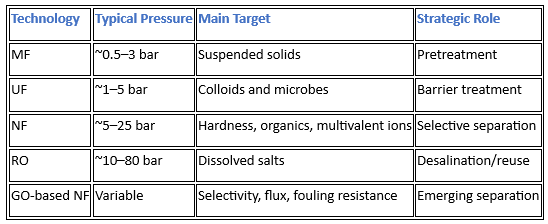
Actual performance varies according to membrane material, feed chemistry, temperature, recovery, and system configuration.
Energy, Recovery, And Concentrate Matter
Energy efficiency is becoming a central design parameter. Brackish-water RO can often achieve approximately 70–90% recovery, while seawater RO commonly operates around 35–50% recovery. Recovery determines how much feedwater becomes product water and how much becomes concentrate.
Consider a plant processing 10,000 m³/day. If membrane optimization reduces electricity consumption by only 0.5 kWh/m³, the plant could theoretically save 5,000 kWh/day, equivalent to approximately 1.825 million kWh/year. At an electricity cost of $0.10/kWh, that represents approximately $182,500 in annual electricity savings.
Hybrid treatment can increase these benefits. UF-RO, NF-RO, and MBR-RO configurations can remove contaminants progressively, reducing the burden placed on high-pressure RO stages.
The New Benchmark: Lifecycle Value
Initial flux is only one performance metric. Engineers should evaluate contaminant rejection, normalized permeability, cleaning frequency, chemical compatibility, membrane replacement intervals, module manufacturability, energy intensity, recovery, concentrate management, and downtime.
Suppose one membrane initially produces 50 L/m²/h, while another produces 40 L/m²/h. The first membrane has a 25% initial flux advantage. However, if its permeability declines by 30% during operation while the second remains comparatively stable, much of the initial advantage disappears.
This is why repeated fouling-cleaning cycles and real wastewater testing are essential. Laboratory performance at controlled pressure and clean feed does not necessarily predict industrial performance over thousands of operating hours.
What Modern Plants Should Choose
For low-turbidity water and microbial barriers, UF typically operates at 1–5 bar, while NF operates around 5–25 bar for hardness, organics, and selective ion removal. RO, operating at approximately 10–80 bar, remains essential for seawater, brackish water, and high-salt removal. Advanced GO, MOF, COF, MXene, and biomimetic membranes are being evaluated for higher flux, rejection, and antifouling performance.
The direction of membrane filtration in 2026 is toward higher selectivity, lower energy consumption, improved recovery, and intelligent control. Seawater RO commonly achieves around 35–50% recovery, while brackish-water RO can reach approximately 70–90%. Combining UF or NF with RO can reduce the contaminant load reaching high-pressure stages and improve overall process efficiency.
At industrial scale, even a 5% improvement in energy efficiency, membrane lifetime, or recovery can significantly reduce operating costs. For a 10,000 m³/day plant, reducing energy consumption by just 0.5 kWh/m³ could save 5,000 kWh/day, or about 1.825 million kWh annually. At $0.10/kWh, this equals approximately $182,500 in potential annual savings, reinforcing the shift toward integrated, data-driven membrane systems.
Reference: https://dataintelo.com/report/global-membrane-filtration-market
Source: DataIntelo