
A Water-Native Solution For Renewable Natural Gas CO2 Emissions
By Dr. Garrett Boudinot
Nearly two thirds of the biogas produced through wastewater treatment is methane, which can be upgraded into renewable natural gas (RNG) — a carbon-neutral fuel source and additional revenue stream for water resource recovery. RNG production requires methane purification or upgrading, which involves separation of the methane from the total biogas, and in the process, venting near-pure carbon dioxide (CO2) to the atmosphere.
Capturing and storing that CO2 can offer an additional resource recovery pathway — and revenue stream — through a new technology that integrates carbon capture and storage with water.
Biogenic CO2, like that vented from biogas upgrading, can be monetized through a range of crediting schemes. Because the biogenic CO2 can be traced to the atmosphere, permanently storing it before it returns to the atmosphere complies with Voluntary Carbon Market crediting schemes, generating well over $100 per ton CO2 by selling carbon credits as offsets. Additionally, in the U.S., capturing and storing CO2 emissions at high enough volumes can qualify for certain tax credits, like 45Q. And when coupled with RNG, capturing and storing the vented CO2 can actually lower the carbon intensity score of that fuel, creating a premium on the RNG itself. These all present significant new revenue opportunities for WWTP already producing RNG, taking advantage of carbon emissions that otherwise would go to waste.
Yet most WWTPs, especially small-to-mid-sized facilities, have historically lacked a feasible pathway to capturing and storing this CO2. Conventional approaches to carbon storage require compressing the carbon on site and transporting it, often by pipeline, to a geological site suited for underground injection. Those sites for geologic injection are few and far between, and just getting the CO2 to the site itself can be an expensive process out of reach of most WWTPs.
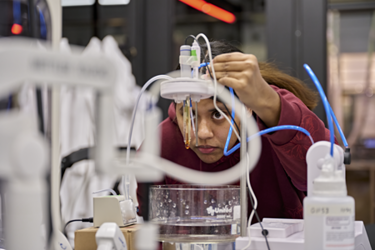
A newer category of technology overcomes that obstacle entirely by leveraging the water itself for permanent storage. Rather than capturing CO2 as a gas and shipping it elsewhere, WWTPs can convert CO2 into dissolved bicarbonate, the same stable chemical form in which the ocean — the world’s largest carbon sink — already holds the vast majority of its carbon. This mirrors the chemical process by which the ocean has regulated atmospheric CO2 for millions of years, as natural elements in the ocean neutralize CO2 into a stable, dissolved bicarbonate form that remains safely and permanently stored. While the chemistry is well understood in chemical oceanography, a new technology — led by companies like the Brooklyn-based startup Vycarb — is able to accelerate, control, and measure the process at the source of CO2, providing a lower cost, easier-to deploy permanent carbon storage solution to unlock the wide range of revenue streams from decarbonization.
That combination of on-site carbon storage paired with continuous measurement is what makes this approach relevant to WWTPs. Most of the physical requirements for storing a plant's own CO2 through this process already exist on-site; WTTPs have simply needed a technology that controllably, safely, and measurably captures and stores that CO2 into the water already flowing through the facility. While many companies and technologies are seeking to use this water chemistry for carbon management, what makes leading companies in the space successful is their ability to directly measure the carbon chemistry in real-time — something that typically requires labor-intensive laboratory analyses — to ensure that the carbon is permanently stored, and that the resulting bicarbonate-rich waters are safe for release and permit-compliant. Without that integrated, high-resolution measurement, the risks of the process — too much alkalinity being added, or too great of a shift in pH, create risks beyond the benefits of carbon capture and storage. Systems built around this kind of verification are better positioned to earn the trust of regulators who have grown appropriately skeptical of carbon offset claims that cannot be independently confirmed.
The resulting bicarbonate is considered one of the most permanent forms of carbon storage — recognized by the IPCC, European Union, the U.S. Department of Energy, and Voluntary Carbon Markets — given the residence time of bicarbonate on the order of 10,000–100,000 years as they move through ocean and coastal water systems. That timescale separates this form of carbon storage from more fleeting carbon offset projects, such as forestry or soil carbon, that can reverse within decades — creating a higher price in voluntary credits, and compliance with other revenue streams like 45Q and low-CI fuels.
The wastewater sector is well-positioned to recover this additional resource — CO2 — and leverage the economic opportunity from it. Rather than continuing to leave money on the table and emit CO2 into the atmosphere, now is the time for WWTPs to recognize the scale of the opportunity presented by fully measurable, water-based CCS, and begin exploring integrating it with their existing infrastructure.
 Dr. Garrett Boudinot is the CEO and founder of Vycarb.