
A Collaboration That Runs Deep: U.S. Army Corps of Engineers And Port Authority of New York and New Jersey
By JoAnne Castagna, Ed.D.
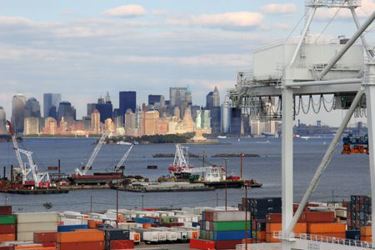
New York City, the cultural and economic power we know today, grew from the waterways that run through it. Over the years, the deepening and widening of the Port of New York and New Jersey allowed ships to bring in goods, foster trade, and carry in immigrants who established communities, industries, and infrastructure. This created one of the most diverse and prosperous cities in the world and a port that is one of the most crucial in the nation.
This wouldn’t be possible without the decades-long collaboration between the U.S. Army Corps of Engineers and the Port Authority of New York and New Jersey.
The Army Corps Dredging Program performs sustainable maintenance dredging and deepening projects for the congressionally authorized waterways within the Port of New York and New Jersey. These projects keep shipping lanes safe and navigable, which supports port activities and the region’s economy.
“The Army Corps takes this responsibility seriously,” says Randall Hintz, Chief of Operations Division New York District, U.S Army Corps of Engineers. “Maintaining the port’s waterways is challenging. We need to deliver, rain or shine, from Montauk Point to Shark River, New Jersey.” Hintz has worked with the Army Corps and Port Authority for almost 39 years.
The Port of New York and New Jersey is located in the northeast coast of the U.S. and is among the top three busiest seaports in the nation.
The seaport has grown into a major global trade hub that contributes greatly to the nation’s economy, supporting over 580,000 jobs, creating $18.1 billion in tax revenue, and moving more than $240 billion in goods annually.
The Port Authority believes its success is due in part to its relationship with the Army Corps. Bethann Rooney, port director for the Port Authority of New York and New Jersey says, “We’ve been working with the Army Corps to make sure the port can safely and efficiently handle larger vessels and constantly increasing cargo volume at the East Coast’s busiest port. Beyond harbor deepening, we’ve also worked closely on other significant projects like annual maintenance dredging and deepening anchorages to enhance safety and flexibility for ships coming and going from the port. We know this is difficult, complex work across the harbor but we’re grateful for our partnership with the Army Corps in getting this important work done.”
Performing maintenance dredging and deepening projects is a massive mission spanning about 31 miles of navigational shipping channels within the Port of New York and New Jersey.
The port is part of a vast system of waterways that includes the historic New York Harbor, considered the heart or largest part of the system. Extending out from the harbor are rivers, bays, and 240 miles of shipping channels that connect to the Atlantic Ocean.
Each year, 2,700 shipping vessels pass through these channels. In 2024, those vessels delivered nearly 8.7 million 20-foot equivalent unit containers filled with clothes, furniture, electronics, and toys, and 2.8 million metric tons of bulk cargo — everything from road salt and cement to cars and orange juice.
To maintain safe waterways for these water vessels, maintenance dredging and deepening projects must be performed in collaboration with other agencies including the U.S. EPA, Department of Transportation, Department of Interior, Department of Homeland Security, Department of Commerce, U.S. Geological Survey, and state and city agencies.
Maintenance dredging must be performed on a regular basis. On the channel’s seabed, silt, clay, and sand sediment naturally accumulates making the waterway unnavigable for ships, so it must be periodically removed through maintenance dredging.
The Army Corps takes hydrographic surveys maps of the seabed to see areas where there is silt and sediment accumulation to determine how much needs to be removed.
To remove this material, the Army Corps goes out on the channels on vessels called dredges.
While on the dredge, they either use mechanical dredging or hydraulic dredging to remove the silt and sediment.
Mechanical dredging involves using mechanical buckets or grabs on cranes to scoop up the material. Hydraulic dredging involves using cutterheads, a rotating shaft with blades, to loosen sediment, which is then sucked up as a water-sediment mixture or slurry through pipes.
Maintenance dredging is performed periodically, but there are times when the port needs to be significantly deepened, primarily to accommodate the new generation of larger cargo ships.
Some of the Army Corps well-known deepening projects have included the 40-foot dredging of the Ambrose Channel in 1999 and more recently in 2014, the 50-foot dredging project of New York Harbor to accommodate the new generation of larger, deeper-draft container ships — or post-Panamax vessels.
Deepening, especially if it’s many feet, often requires drilling and underwater blasting to break up the material on the seabed, especially if it is composed of hard bedrock. To break up the bedrock an excavator is first used to remove as much rock as possible. After this, small underwater explosives are set off to break up the rock that is then removed by excavator.
The Port Authority understands that this is no easy task. Rooney says, “Believe it or not, New York Harbor is naturally shallow. If you go below the water to areas that haven’t been dredged, you’ll hit rock at only 16 feet. It’s very solid, 450-million-year-old bedrock, the same bedrock that provides a strong foundation for Manhattan skyscrapers. That means it’s a long, methodical process to blast that bedrock when dredging work takes place.”
The dredge material, whether from maintenance dredging or deepening projects, is carried away by hopper dredges, pipeline dredges, and barges to disposal areas.
Instead of just disposing of the material, the Army Corps and Port Authority together find ways to use it beneficially.
“Most of what’s dredged is used to rebuild wildlife habitats, strengthen shorelines, and support sustainable redevelopment across the region including areas like the Bayonne Golf Course and the parking lot at the Jersey Gardens Mall in Elizabeth,” says Rooney.
Lisa Baron, project manager, New York District, U.S. Army Corps of Engineers says many of these beneficial use projects are in the New York boroughs of Queens and Brooklyn.
She said, “In Jamaica Bay, dredge material is planned to restore Stony Creek and Duck Point Marsh Islands providing significant ecological and coastal storm risk benefits to adjacent Queens communities. In Brooklyn, dredged material is planned to be used to recontour the bottom of Fresh Creek to improve habitat and hydrology. In addition, dredged material will be used this summer to restore the degraded wetlands and raise the marsh platform in Spring Creek North while also restoring one of its tributaries, improving the coastal resiliency of adjacent communities.”
For decades, the Army Corps Dredging Program has worked closely with the Port Authority on the maintenance dredging and deepening of the port and beneficially using dredge material to improve the environment. This work will continue well into the future.
By 2050, the Port Authority foresees cargo volumes doubling or tripling from the pre-pandemic levels, requiring the port to be deepened further to accommodate the growing activity. Because of this, the Army Corps in collaboration with the Port Authority is advancing plans to deepen the port from 50 to 55 feet to enable large ships to safely navigate into the port as they have been doing for a century.
 Dr. JoAnne Castagna is a public affairs specialist and writer for the U.S. Army Corps of Engineers, New York District. She can be reached at joanne.castagna@usace.army.mil.