
LABOR RESOURCES FOR UTILITY MANAGERS
-

Managed services can help water utilities control digital complexity, address cybersecurity and obsolescence risks, and turn connected infrastructure data into actionable operational insights.
-

Better user interface (UI) and user experience (UX) design can help water utilities preserve operator knowledge and bring new hires up to speed.
-
 For several years, the PFAS conversation has centered on treatment options, testing, and funding. Those factors still matter, but they are no longer the primary constraint. Most utilities already understand the treatment routes available to them; the real challenge now is moving from technical possibility to operational performance, and that depends entirely on people.
 -
 Utilities can refill a vacancy. They cannot rehire the judgment that kept a system stable at 2 a.m. The work now is to preserve that judgment without taking the operator out of command.
 -
 As water and wastewater utilities expand SCADA, advanced analytics, and AI, managers must prepare operators to turn those signals into reliable operational decisions. The goal is not to replace certified professionals but to build an augmented workforce that can supervise automation, question model outputs, and protect treatment performance under changing plant conditions.
 -
 A discovery at ACE26 offers practical ideas for attracting, developing, and retaining the next generation of water professionals.
 -
") Attracting engineering talent remains one of the water industry's biggest workforce challenges. It isn't that there aren't enough engineers; it's that the water sector often undersells careers that already offer exactly what today's engineering candidates are looking for.
Attracting engineering talent remains one of the water industry's biggest workforce challenges. It isn't that there aren't enough engineers; it's that the water sector often undersells careers that already offer exactly what today's engineering candidates are looking for. -
 Utilities across the U.S. are facing growing pressure from aging infrastructure, climate resilience demands, regulatory scrutiny, and a workforce approaching retirement. Yet despite the scale of the challenge, much of the industry is still drawing talent from the same narrow pools and approaching hiring the same way it did years ago. That approach is becoming increasingly unsustainable.
 -
 Many utilities are asking a practical question: How do we move beyond hype and implement AI in a way that delivers measurable, sustainable value? At the Central Valley Water Reclamation Facility (CVWRF), the answer has been to focus less on tools and more on readiness.
 -
 The water sector has evolved from a mostly mechanical industry into one driven by software and data. What hasn’t kept pace is the workforce.










UTILITY MANAGEMENT VIDEOS
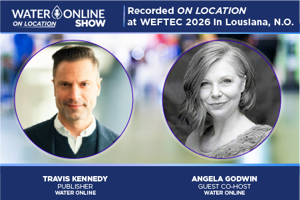
Tune into the latest episode of The Water Online Show: On Location to check in with Travis Kennedy and Angela Godwin as they walk the show floor at WEFTEC 2026.