
High energy electron injection system destroys MTBE in drinking water
This is the conclusion of a two-part series dealing with emerging treatment options for removing MTBE (methyl-tert-butyl-ether) from drinking water supplies. In the first article, Synthetic Adsorbents Show Promise for Removing MTBE from Drinking Water, the ability of synthetic adsorbents to extract MTBE from water was covered. The authors now discuss high-energy electron injection as a method for achieving the destruction of MTBE so that drinking water standards can be met.
By Paul M. Tornatore, Dr. Susan E. Powers, Dr. William J. Cooper and Eric G. Isacoff
Table of Contents
How high energy electron beam technology works
Testing electron beam injection on contaminated water
Studies carried out on deep well water for MTBE only
Potential as future drinking water process should be explored
As in the case of sorption with synthetic media, a destructive process using high energy electron injection has been demonstrated on a pilot scale, which addresses MTBE, tert-butyl alcohol (TBA), and other MTBE reaction intermediates, and has the capability to achieve the requirements of the drinking water standards with low operating costs.
How high energy electron beam technology works
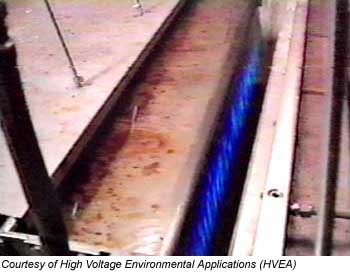
Electron beam technology can be applied as a treatment process for contaminated water and other media. The innovative process works on aqueous streams and uses high-energy electron injection to create effective treatment chemistry, and provides instantaneous contaminant degradation and ultimate destruction. Unlike the sorbent processes previously discussed, treatment with the electron beam system creates no waste stream for further handling and disposal, a distinct advantage in many applications. A photograph of an operating electron beam in a water treatment application is shown below.
The electron beam process is considered a member of the family of advanced oxidation technologies.
Unlike conventional AOTs using ultraviolet light, hydrogen peroxide, ozone or other oxidants, the electron beam creates a unique combination of oxidizing and reducing chemistry, in approximately equal amounts, from electrical energy alone.
An operating electron beam treatment system delivers a continuous stream of high-energy electrons that pass through a scanner to create a finite pattern at a finite frequency. The shape and frequency of this pattern is controlled to apply a uniform quantity of electrons (dose) to the water stream in the unit delivery system. When high-energy electrons penetrate water, some of the water molecules dissociate, creating hydroxyl radicals, hydrogen radicals and free aqueous electrons. This combination of constituents creates a unique chemical environment where oxidizing and reducing chemistry is present at approximately equal levels. The oxidizing and reducing species are largely responsible for the treatment effects of the process, causing instantaneous reactions in the presence of contaminants. (Return to Table of Contents)
Testing electron beam injection on contaminated water
A series of experiments was performed in Southern California at the Orange County Water District (OCWD) in the spring of 1999, using water sources spiked with a fixed concentration of MTBE. One goal of the OCWD tests was replication of prior tests performed in Miami, FL at an electron beam research facility. Each of the experiments were designed to develop a dose response curve showing MTBE degradation vs. energy application, and the testing performed at OCWD was further designed to evaluate the degradation rates of reaction intermediates tert-butyl alcohol (TBA) and tert-butyl formate (TBF). Both of these compounds are formed, and difficult to eliminate when conventional advanced oxidation processes are applied to MTBE treatment. Elimination of reaction intermediates without substantially increasing applied energy rates suggests the electron beam process is a viable alternative for future drinking water applications. (Return to Table of Contents)
Studies carried out on deep well water for MTBE only
This water sample is characterized by relatively low TOC (total organic carbon), the average was 4.09 mg/L, an alkalinity of 158 and a hardness of 19.1 mg/l as calcium carbonate (CaCO3), and a pH of between 7.7 and 8.8. Two experiments with only MTBE were conducted using this source water. The data obtained for the destruction of MTBE in deep well water are summarized in Tables 1 and 2.
The numbers for the reaction by-products tert-butyl alcohol and tert-butyl formate are also given. The data are tabulated as both weight and molar concentrations. The reason for the conversion to molarity is to account for the differences in molecular weight of the three different compounds. To analyze data for removal efficiencies and reaction by-product formation and loss for a variety of compounds, it is necessary to convert all of the concentrations into molar units.
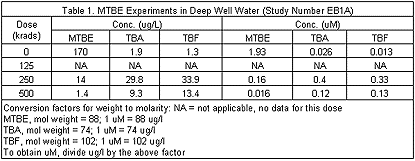
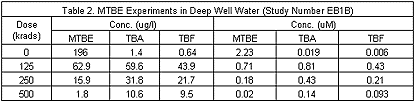
The data show excellent MTBE reduction at low applied energy rates. In addition the data shows a sequential formation of TBA and TBF, followed by rapid reduction at slightly higher energy rates. A preliminary comparison of results indicates the ability to meet treatment guidelines for MTBE and reaction intermediates TBA and TBF at energy rates slightly greater than required for MTBE only. Since the treatment of reaction intermediates is controlled by reduction chemistry, high-energy electron injection has a distinct competitive advantage as a result of its unique oxidizing/reducing chemistry.
This test demonstrated clearly the ability of the oxidizing and reducing chemistry produced by the electron beam to treat multiple constituents simultaneously, a unique feature with great promise for other drinking water applications.
Energy rates required during the Orange County experiments were slightly higher than previous work done in Miami, largely attributed to the presence of carbonate hardness in the native groundwater of southern California. A pH adjustment would mitigate the competitive effects of hardness on an actual treatment application. Resulting energy requirements to reduce MTBE from 1 mg/l to below California's secondary treatment standard of 5 ug/l would represent a treatment cost of approximately $0.30 per thousand gallons, competitive with typical conventional treatment alternatives applied to MTBE. (Return to Table of Contents)
Potential as future drinking water process should be explored
Like synthetic adsorbents, the high-energy electron injection approach has been demonstrated as a viable process option for meeting MTBE removal objectives at low cost in various water treatment applications. While the operating costs of the system are comparable to the synthetic adsorbent method, the higher capital costs of an electron beam installation would appear to be a better fit in high-volume drinking water treatment situations.
The process showed its ability to meet required maximum contaminant levels (MCLs) with lower energy consumption than competing oxidation technologies, and the electron beam demonstrated that it can destroy reaction intermediates simultaneously. As in the case of synthetic adsorbents, additional investigatory work should be undertaken to explore the potential of the electron beam process in terms of its efficiency and economics.
About the Authors: Paul M. Tornatore, P.E., is vice president of the consulting firm Haley & Aldrich, Inc., Rochester, NY. Susan E. Powers, Ph.D, is on the staff of Clarkson University, Potsdam, NY. William J. Cooper, Ph.D, is at the University of North Carolina, Wilmington, NC. Eric G. Isacoff is global technical manager for the Customer Solutions Group of the Rohm and Haas Company, Philadelphia, PA.
References
Brown, A., Devinny, J. S., and Davis, M. K. (1997). "A Review of Potential Technologies for the Treatment of Methyl tertiary Butyl Ether (MTBE) in Drinking Water." Proceedings of the 1997 American Petroleum Institute and National Groundwater Association Conference on Petroleum Hydrocarbons and Organic Chemicals in Groundwater: Prevention, Detection, and Remediation. Houston, TX, Nov. 12-14.
Cooney, C. M. (1997). "California Struggles with Presence of MTBE in Public Drinking WaterWells." Environ. Sci. Technol., 31(6), 269.
Davis, S.W., and Powers, S.E., (2000). "Evaluation of Alternative Sorbents for Removal of MTBE from Groundwater." In press, Journal of Environmental Engineering (to be published April 2000).
Gallup, D.L., Isacoff, E.G., and Smith, D.N., III (1996). "Use of Ambersorb Carbonaceous Adsorbent for Removal of BTEX Compounds from Oil-Field Produced Water." Environ. Prog., 15(3), 197-203.
Hand, D. W., Herlevich Jr., J. A., Perram, D. L., and Crittenden, J. C. (1994). "Synthetic Adsorbent versus GAC for TCE Removal." J. AWWA, 86(9), 64-72.
Hradil, J., Svec, F., Podlesnyuk, V.V., Marutovskij, R.M., Friedman, L.E., and Kliemenko, N.A. (1991). "Sorption and Desorption of Organic Compounds by Synthetic Polymeric Sorbents." Ind. Eng. Chem. Res., 30, 1926-1931.
Malley, J.P., Eliason, P.A. and Wagler, J.L. (1993a). "Point-of-Entry Treatment of Petroleum Contaminated Water Supplies." Water Env. Res., 65(2), 119-128.
Malley, J.P., Locandro, R. R. and Wagler, J. L. (1993b). "Innovative Point-of-Entry (POE) Treatment for Petroleum Contaminated Water Supply Wells." Final Report, USGS New Hampshire Water Resources Research Center, Durham, NH.
Mendancino, F. (1998). Calgon Carbon, Inc., Personal Communication, September 28, 1998.
Plantz, D.A. (1998). Rohm and Haas, Personal Communication, October 7, 1998.
Sevilla, A., Beaver, P.and Cherry, P. (1997). "Effect of MTBE on the Treatability of Petroleum Hydrocarbons in Water." Preprints of Papers, 213th National Meeting of the American Chemical Society, Division of Environmental Chemistry, 37(1), 403-405.
USEPA (1995). "Demonstration of Ambersorb 563 Adsorbent Technology." EPA-540-SR-95-516.
USEPA (1998). "Oxygenates in Water: Critical Information and Research Needs." EPA/600/R-98/048, Office of Research and Development, Washington D.C.